
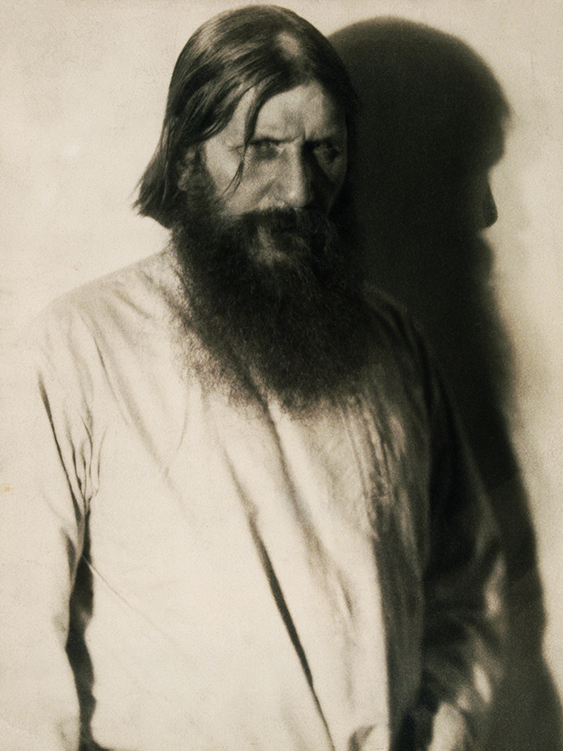
Grigori Rasputin, the Russian mystic and faith healer, was born to a muzhik (peasant) family in western Siberia in 1869. Siberia’s desolate immensity of tundra and reindeer pasture was described by Dostoevsky, in his prison memoir The House of the Dead (1862), as a “lonely steppe”. Rasputin is unlikely to have read that book – he was scarcely literate – but with his deep-glaring eyes and long unkempt hair he could have been a religious fanatic straight out of Dostoevsky. Rasputin (“Russia’s greatest love machine,” in the words of Boney M) is among the most divisive and mysterious figures in Russian history; his journey from obscurity to the heart of power has the flavour of myth.
Antony Beevor cuts through the myth-making to give us a fascinating, evidence-based biography that absorbs throughout. Rasputin was not a revolutionary, Beevor writes, but his Svengali-like control over the imperial household in St Petersburg caused ordinary Russians to turn against the monarchy and helped precipitate the anti-Romanov uprising of 1917. Often drunk and belligerent, Rasputin used his “mesmerising stare” to seduce and (so it was rumoured) financially exploit credulous society women. This scrupulously researched book helps explain how a social-climbing, charismatic mystic from Siberia helped bring down one of the world’s oldest autocracies.
For Tsar Nicholas II and his German-born wife, Alexandra, Rasputin embodied the peasant spirituality of the Russian Old Believer sect that broke from mainstream Orthodox Christianity in the 17th century. Many of the Old Believers who fled Muscovite authority settled in Siberia. Like the Amish in the US, they refused to shave their beards or wear Western clothes. They were derided as raskolniki – schismatics. That is the meaning behind the name of the impoverished student Raskolnikov in Dostoevsky’s novel Crime and Punishment (1866). Like Rasputin, he is an outsider. Rasputin held no official position in the Russian Orthodox Church. In his youth, he had done penance as a strannik (wandering pilgrim) by walking barefoot from village to village in heavy chains. Empress Alexandra, a fervent Orthodox convert, was so smitten with Rasputin that she reverently kissed his hands and filled her St Petersburg chapel with candlelit icons of the Russian saints.
Rasputin arrived in the imperial capital a couple of years before Bloody Sunday, or the First Russian Revolution of 1905, which was sparked when Cossack troops shot dead unarmed protesters marching on the Winter Palace with a petition to improve working conditions. Unrest spread across Russia’s western borderlands into the tsarist Baltic provinces. In the proliferating violence, Baltic German manor houses were burned down and landlords killed. Worker councils – soviets – sprang up as factory hands set up Marxist study circles and cooperatives. Nicholas II was forced to accept an embryonic parliament, known as the Duma; he quickly dissolved it, however. Bloody Sunday was the first warning call before the Bolshevik revolution of 1917 overthrew the tsars for good.

Like Nicholas II, Rasputin did not believe in democracy. These were years of turmoil for St Petersburg. but its northern elegance “cannot have failed to impress” the provincial Rasputin, writes Beevor. Peter the Great had built the city’s Venetian waterways and classical facades on the swamp bog where the River Neva enters the Gulf of Finland. To his St Petersburg patrons, Rasputin could never quite belong in this world. In the popular imagination, Siberia was a land of shamans and soothsayers who ate reindeer innards and quantities of elk meat. Rasputin ingratiated himself into St Petersburg salons where aristocrats indulged the table-rapping and spook-dabbling of spiritualism and the occult. “Mysticism had completely taken over Russian high society,” Beevor comments.
By the time Rasputin was introduced to Nicholas II in November 1905 the tsarist empire was in its dying days. Bloody Sunday was scarcely a memory when Russia suffered a catastrophic naval defeat during its ill-conceived war against Japan. Four Russian battleships and a number of cruisers and destroyers were sunk in the Straits of Tsushima between the Korean peninsula and Japan; up to 5,000 Russian sailors drowned. The national humiliation was compounded when Black Sea fleet sailors in Odesa mutinied against their harsh discipline and, as Eisenstein memorably portrayed it in the film Battleship Potemkin (1925), their maggot-infested rations. All over Russia, an atmosphere of janitorial gloom descended as Jews were locked up or killed as if they were “somehow responsible” for the unrest, writes Beevor. No imperial power was more reviled at this time than Nicholas II’s. The Labour MP and future prime minister, Ramsay MacDonald, called the tsar a “common murderer” as well as an anti-Semite.
On some level, Nicholas II and his wife hoped that Rasputin might protect them against the threat of further revolution. The peasant “man of God” was living proof that the Almighty supported the tsar’s autocracy and divine right to rule. The pan-Slavic values of Orthodoxy, autocracy and nationhood had been passed down to Nicholas II from his father, Alexander III, and great-grandfather Nicholas I. Himself a virulent anti-Semite, Nicholas I had espoused the Slavophile cause during the Crimean War of 1853-56, when he vowed to drive the Muslims out of Europe and raise the flag of Orthodox Christianity over Constantinople. Russian nationalists railed against the West’s perceived betrayal of the Christian cause at Crimea: Britain and France had allied with the Ottoman enemy in order to defend their own imperial interests. Nicholas II’s idealised vision of a Holy Russia – one opposed to the godless materialism of the West – found its apotheosis in Rasputin.
Empress Alexandra’s devotion to “our friend” (as she called Rasputin) redoubled after he was seen to heal her son Alexei of his haemophilia. Beevor concludes that the cause of Alexei’s temporary remission is uncertain. Some historians have argued that Rasputin used hypnotic suggestion; others, that he disallowed aspirin, then commonly used to relieve pain, but unknown as an anti-clotting agent until the 1950s. (As a blood thinner, aspirin was ineffectual against haemophilic bleeding.) Of course, Rasputin’s miracle-working only confirmed his “closeness to God” in Alexandra’s eyes. He became an indispensable member of the royal entourage and had a ringside seat at the Romanov tercentenary celebrations of 1913, when Russians were exhorted to show their loyalty to the 300-year-old Romanov autocracy. Nicholas II was filmed for the occasion; in his sumptuous finery, he looked dangerously out of touch. No amount of commemorative biscuit tins and cigar boxes emblazoned with eagles could help bridge the chasm between the tsar and his subjects. To his enemies, Rasputin’s presence at the tercentenary was a violation of the established social order.
A campaign was launched to defame him. It was whispered that Rasputin had access to the palace nursery, where Empress Alexandra’s four teenage daughters slept in their nightgowns. A nursemaid claimed that he had raped her. Rasputin had been so bold as to seduce even Alexandra. No evidence exists to prove any of these accusations, writes Beevor. Rasputin made things worse for himself by preaching that physical contact with women purified the soul. Stories of his debauched behaviour in Siberia filtered back to St Petersburg. Creepily, Rasputin turned sexual temptation into purification by frequenting St Petersburg bath-houses, where, as Beevor puts it, women were persuaded to “wash his most intimate parts”. None of this had very much to do with the redemptive spirit of Slavonic Orthodoxy. Scurrilous foreign cartoons of Rasputin’s penis (rumoured to be 12 inches long) were captioned: “Tiller that steers Russia.”
On the suspicion that Rasputin was a covert revolutionary, he was tailed by the tsar’s secret police, the Okhrana. In 1914, a 33-year-old woman stabbed him in the stomach on one of his trips to Siberia. Though seriously wounded, Rasputin recovered. The assassin claimed to have acted alone but she was probably sent by Russia’s ultra-nationalist Black Hundreds, who loathed Rasputin and the royal household’s indulgence of him. The anti-Rasputinards wanted him dead: he had discredited the monarchy and alienated the Russian people.
Rasputin’s power was at its height in 1915, when Nicholas II left St Petersburg to take charge of the Imperial Russian Army in the First World War. Rasputin strongly opposed the war. He warned Alexandra that it would lead to the Russian empire’s collapse. She did not always care to listen to him. Initially the war had gone well for Russia; crowds cheered the troops as they left Petrograd (no longer St Petersburg: the name was judged too German-sounding). Russian forces moved effortlessly into East Prussia and Galicia but the tsar’s successes were short-lived. By late 1915 German troops had pushed the enemy back and penetrated deep into the Russian empire. Rasputin was blamed for the losses and accused of being a German spy in league with Alexandra, who was the German-born granddaughter of Queen Victoria and first cousin of Kaiser Wilhelm II. Ludicrously, the champion of Russian Orthodoxy was now perceived as an agent of Germany.
Rasputin was murdered by a group of outraged nobles in St Petersburg early one December morning in 1916. His body was dumped through a hole in the ice in the Neva in the hope that it would wash out to the Gulf of Finland. (It did not.) Empress Alexandra, grief-stricken, was prescribed drafts of Veronal barbiturate and retreated further into herself. Nicolas II, stubborn to the end, continued to believe in the absolutist rule that had bolstered the tsars for generations. But with Petrograd on the brink of a second revolution and the Russian army in disarray, he was left with no choice but to abdicate. On 15 March 1917, in a train carriage close to the Estonian border, he signed the abdication papers.
The Bolsheviks, in a surge of sans-culotte violence, declared Russia a republic, and in 1918 they moved the capital from Petrograd to Moscow. The tsar and his family were murdered six months later, in July, while under prison guard in the Siberian city of Yekaterinburg. The walls leading downstairs to the basement were daubed by the Red Guards with obscene depictions of Rasputin receiving oral sex from the empress. One of the executioners recalled the haphazard nature of the shootings: “Take Alexei, it took a lot of bullets before he died. He was a tough kid.” (A formidable enemy: a 13-year-old haemophiliac.)
Rasputin and the Downfall of the Romanovs, this readable and wonderfully informative biography, opens a window on to the fantasy world of the Russian royal couple and their delusion that a soothsayer from Siberia could ever be their salvation.
Rasputin and the Downfall of the Romanovs
Antony Beevor
Weidenfeld & Nicolson 384pp, £25
Purchasing a book may earn the NS a commission from Bookshop.org, who support independent bookshops
[Further reading: In defence of Ulysses]
Content from our partners



Related



This article appears in the 18 Mar 2026 issue of the New Statesman, The new world war
Join the debate
Subscribe here to comment